Max
Max 
Artificial intelligence is rapidly moving from controlled laboratory environments into the heart of enterprise operations. From customer service bots to autonomous decision-making systems, AI models are now embedded in workflows that directly affect revenue, reputation, and regulatory compliance. Yet the security discipline around these systems remains immature and attackers are already exploiting that gap. An AI red teaming platform is no longer a luxury for forward-thinking security teams; it is a foundational requirement for any organization serious about deploying AI safely at scale.
What Is an AI Red Teaming Platform?
Traditional red teaming involves human experts simulating adversarial attacks to uncover vulnerabilities before malicious actors do. When applied to AI systems, red teaming extends this practice to the unique failure modes that machine learning models introduce: prompt injection, jailbreaking, data poisoning, model inversion, and adversarial input manipulation, among others.
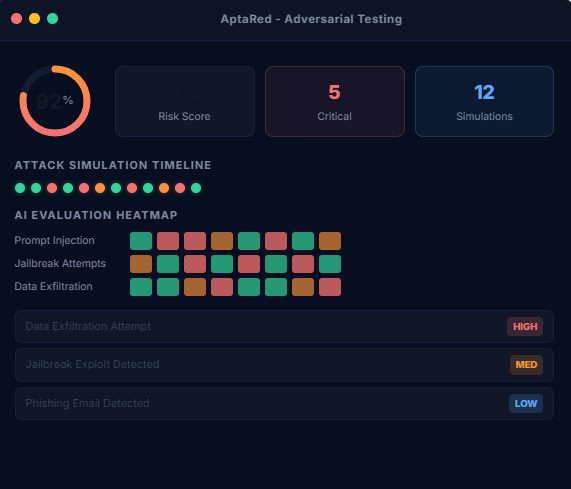
An AI red teaming platform operationalizes this discipline. Rather than relying on occasional, labour-intensive manual assessments, a dedicated platform allows security teams to run continuous, systematic evaluations against their AI models and agent pipelines. It provides structured test cases, tracks findings over time, and integrates with existing security workflows turning a one-off exercise into an ongoing security practice.
The value proposition is straightforward: AI models change frequently, and each update can introduce new vulnerabilities. A static assessment performed during initial deployment becomes irrelevant within weeks as the underlying model is fine-tuned, retrained, or integrated with new tools and data sources. Only a persistent, automated evaluation capability can keep pace with that rate of change.
The Growing Threat Landscape for AI Systems
The threat landscape targeting AI systems has grown significantly more sophisticated in the past two years. Nation-state actors and financially motivated criminals alike have recognized that AI systems represent a new attack surface with distinctive properties. Unlike traditional software vulnerabilities, AI weaknesses are often non-deterministic, difficult to detect through conventional scanning, and can produce harms that are subtle and cumulative rather than immediately visible.
Prompt injection attacks where malicious instructions hidden in user input or external data redirect an AI agent’s behaviour have emerged as one of the most prevalent and dangerous attack classes. Adversarial inputs that cause misclassification or harmful outputs are another growing concern, particularly in high-stakes domains like financial fraud detection, medical diagnostics assistance, and content moderation. Without systematic testing, organizations often have no reliable visibility into whether their AI systems are vulnerable to these attacks.
Automated AI Red Teaming USA: Closing the Coverage Gap
One of the most significant developments reshaping enterprise AI securities in the United States is the rise of automated AI red teaming USA. Manual red teaming by skilled practitioners is valuable, but it is inherently limited by time, cost, and human bandwidth. A single engagement might produce dozens of test cases; automated systems can generate thousands covering a far broader attack surface and doing so continuously rather than periodically.
For organizations in the USA navigating a complex regulatory environment including emerging frameworks from NIST, the executive order on AI safety, and sector-specific guidance from agencies like the FDA and OCC automated red teaming also provides the documentation and audit trails necessary to demonstrate due diligence to regulators and auditors.
Leading automated AI red teaming solutions go beyond simple input fuzzing. They incorporate knowledge of known attack taxonomies, leverage adversarial machine learning techniques, and can simulate sophisticated multi-step attack chains that mirror real-world threat actor behavior. This depth of coverage is simply not achievable through manual methods alone.
What to Look for in an AI Red Teaming Platform
Not all platforms are created equal. When evaluating an AI red teaming platform for enterprise deployment, security leaders should consider several critical capabilities. First, the platform should support a broad range of AI attack classes not just prompt injection, but also model extraction, membership inference, and agentic attack scenarios where AI systems interact with tools, APIs, and external data sources.
Second, integration matters enormously. The most effective platforms connect directly into CI/CD pipelines, enabling security testing to occur automatically whenever a model is updated or a new agent configuration is deployed. This eliminates the manual handoff that so often causes security assessments to be skipped during fast-moving development cycles.
Third, reporting and remediation guidance should be actionable. Identifying a vulnerability is only the first step; the platform should help security and development teams understand what the finding means, what the risk is, and what steps will remediate it effectively.
Building a Security-First AI Program
Organizations that invest in an AI red teaming platform today are positioning themselves ahead of a regulatory and threat curve that is only going to steepen. The companies that treat AI security as an afterthought bolting on assessments after deployment rather than building testing into their development lifecycle will find themselves repeatedly responding to incidents rather than preventing them.
AptaSentry has built its platform specifically to address the enterprise AI security challenge. By combining automated AI red teaming capabilities with deep expertise in agentic AI attack scenarios, AptaSentry gives security teams the visibility and confidence they need to deploy AI responsibly and defensibly. Whether you are protecting a customer-facing LLM application, an internal knowledge base, or a complex multi-agent workflow, the right red teaming platform is your first line of defense.
The question for enterprise security leaders today is not whether to invest in AI red teaming it is whether to act before or after a serious incident forces the issue. The organizations choosing to act proactively are building durable competitive advantages in trust, resilience, and regulatory confidence.